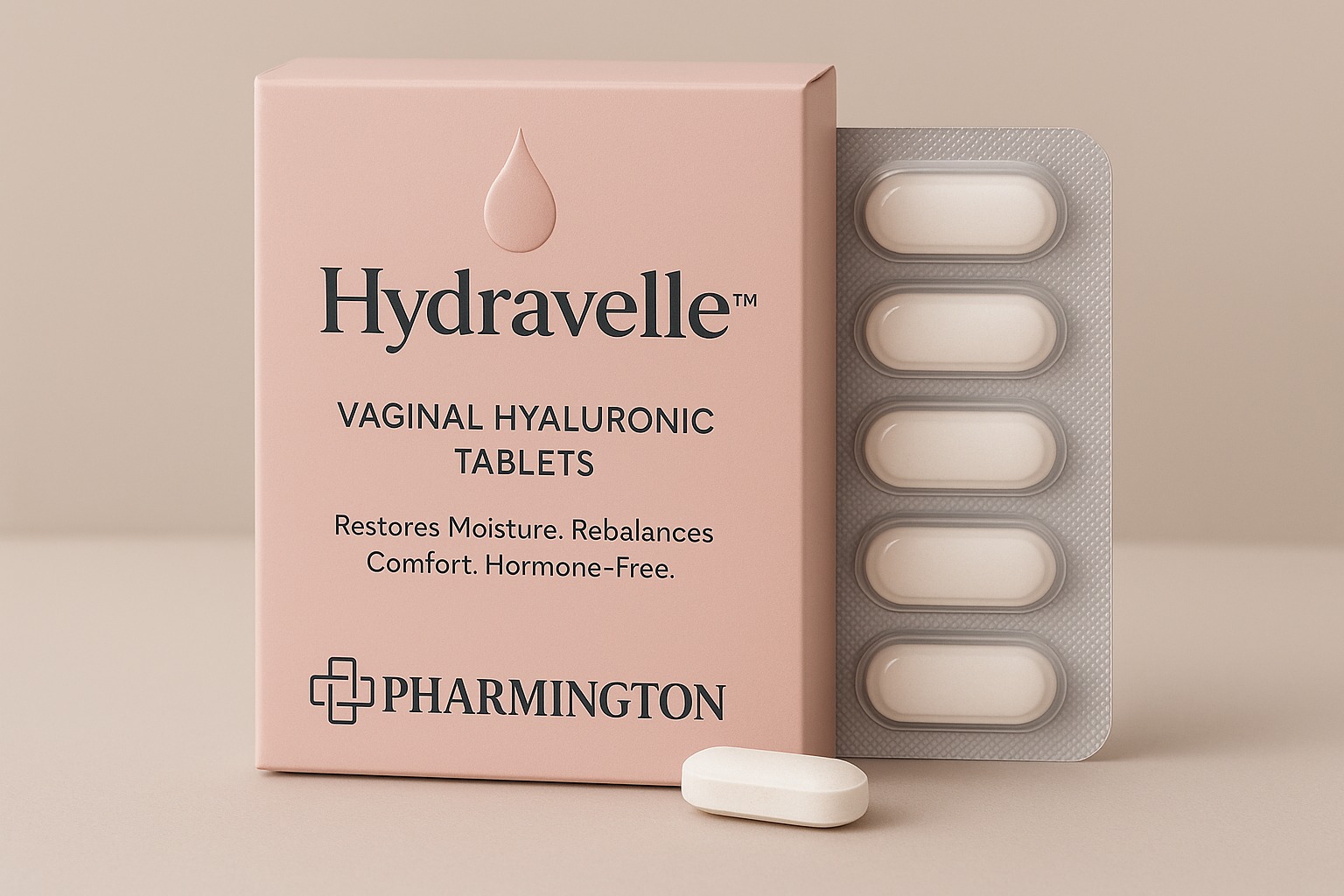
Hydravelle® is a next-generation intravaginal tablet formulated with ultra-pure hyaluronic acid, designed to restore moisture, enhance elasticity, and support mucosal healing in the intimate area.
Each tablet provides long-lasting hydration by binding water molecules to the mucosal tissue, improving comfort and resilience — especially useful for women experiencing dryness, irritation, or discomfort due to menopause, hormonal changes, or postpartum recovery.
Deep, lasting hydration of vaginal tissue
Supports natural regeneration and pH balance
Relieves itching, burning, and dryness
Hormone-free and preservative-free
Clinically tested biocompatible hyaluronic acid
Hyaluronic acid (high molecular weight), lactitol, trehalose, microcrystalline cellulose, magnesium stearate.
No parabens, fragrances, or hormones.
Insert 1 tablet daily for 7 days, then 2–3 times weekly as maintenance or as directed by your gynecologist
£19.59
Vaginal health is an essential component of women’s overall well-being and quality of life, yet it is frequently affected by physiological and hormonal transitions such as menopause, postpartum recovery, lactation, and medical interventions that alter estrogen signaling. One of the most prevalent manifestations of vaginal tissue imbalance is vaginal dryness, often accompanied by irritation, burning sensation, dyspareunia, and increased susceptibility to microinjuries.
Conventional management strategies have historically relied on local estrogen therapy; however, concerns regarding hormonal exposure, contraindications, and patient preference have driven increasing interest in non-hormonal, tissue-supportive alternatives. In this context, bioengineered biomolecules that mimic physiological hydration mechanisms have gained substantial scientific attention.
Hydravelle® Vaginal Tablets represent a modern intravaginal formulation designed to support vaginal mucosal hydration and regeneration through non-hormonal pathways. Centered on ultra-pure, high–molecular-weight hyaluronic acid, Hydravelle® aligns with contemporary understanding of extracellular matrix biology, mucosal barrier preservation, and moisture regulation. This article provides a scientific review of the biological rationale, mechanistic foundations, and clinical relevance of Hydravelle® for vaginal tissue support.
The vaginal mucosa is a dynamic, hormone-responsive tissue characterized by stratified squamous epithelium, rich vascularization, and a collagen- and glycosaminoglycan-rich extracellular matrix. Under physiological conditions, estrogen promotes epithelial thickness, glycogen production, lactic acid–mediated pH regulation, and adequate tissue hydration.
When estrogen levels decline or fluctuate—as occurs during menopause, postpartum recovery, or iatrogenic hormonal suppression—vaginal tissue undergoes morphological and functional changes. These include epithelial thinning, reduced elasticity, diminished secretion, altered microbiota, and increased transepithelial water loss. Importantly, these changes reflect local tissue-level dysfunction rather than systemic pathology. (1,2)
Recognition of this distinction has informed therapeutic strategies that aim to restore mucosal hydration and barrier integrity without directly manipulating endocrine signaling.
Hyaluronic acid (HA) is a naturally occurring, non-sulfated glycosaminoglycan composed of repeating disaccharide units of N‑acetylglucosamine and glucuronic acid. It is a major structural component of the extracellular matrix in skin, connective tissues, and mucosal surfaces. (3)
High–molecular-weight hyaluronic acid exhibits unique physicochemical properties, including remarkable hygroscopic capacity and viscoelasticity. Each HA molecule can bind up to 1,000 times its weight in water, forming a hydrated matrix that supports tissue lubrication, mechanical resilience, and cellular migration. (4)
Within vaginal tissue, hyaluronic acid contributes to:
Experimental and clinical studies have demonstrated that topical or intravaginal application of hyaluronic acid improves vaginal moisture content, reduces dryness-associated symptoms, and enhances tissue comfort—particularly in estrogen-deficient states. (5,6)
These properties position hyaluronic acid as a biologically credible, non-hormonal agent for vaginal tissue support.
The therapeutic relevance of hyaluronic acid depends not only on its molecular presence but also on its formulation and delivery system. Hydravelle® Vaginal Tablets are engineered for intravaginal administration, allowing localized exposure while minimizing systemic absorption.
The tablet matrix is designed to gradually hydrate upon contact with vaginal moisture, facilitating controlled release of hyaluronic acid and prolonged mucosal contact. This localized, sustained hydration mechanism mirrors physiological extracellular matrix function and enhances tolerability.
In addition to hyaluronic acid, Hydravelle® incorporates lactitol and trehalose—functional excipients known for their osmoprotective and moisture-stabilizing properties.
Trehalose contributes to cellular membrane stabilization and protection against dehydration-induced stress, while lactitol supports osmotic balance without disrupting the vaginal microbiological environment. Microcrystalline cellulose and magnesium stearate ensure tablet integrity and uniform dispersion without introducing irritants.
Together, these components support a balanced microenvironment conducive to mucosal comfort and regeneration.
Loss of tissue hydration is a central factor in vaginal discomfort and dryness-related symptoms. Dehydrated mucosa becomes mechanically fragile, more susceptible to irritation, and slower to recover from microtrauma.
By restoring water content and forming a protective matrix over the vaginal epithelium, hyaluronic acid–based formulations such as Hydravelle® address:
This moisture-restorative approach targets symptom-generating mechanisms rather than hormonal signaling pathways. (7)
A critical distinction must be emphasized: Hydravelle® is not a hormonal therapy. It does not contain estrogen, progesterone, or hormone-like compounds, nor does it influence endocrine feedback mechanisms.
Instead, Hydravelle® supports vaginal tissue by:
This non-hormonal positioning makes Hydravelle® suitable for women seeking hormone-free vaginal support, including those with contraindications to estrogen-based therapies or personal preference for non-endocrine interventions. (8)
Hyaluronic acid is widely recognized for its excellent biocompatibility, minimal immunogenicity, and favorable safety profile. Its extensive use in dermatology, ophthalmology, orthopedics, and gynecology underscores its tolerability in both topical and mucosal applications.
Hydravelle® Vaginal Tablets are formulated without:
Available evidence supports the safe use of intravaginal hyaluronic acid preparations for long-term supportive care when used as directed. Nevertheless, individualized clinical assessment remains essential, particularly in patients with recurrent infections or complex gynecological conditions. (9)
In contemporary gynecologic practice, non-hormonal vaginal therapies play an increasingly important role as adjuncts or alternatives to conventional interventions. Hydravelle® is positioned within this integrative framework as a supportive option aimed at restoring vaginal moisture and comfort rather than modifying systemic physiology.
Its formulation reflects a convergence of biomaterials science, mucosal biology, and patient-centered care, offering a localized, non-invasive approach aligned with modern clinical priorities.
Hydravelle® Vaginal Tablets exemplify an evidence-informed, non-hormonal strategy for supporting vaginal mucosal hydration and tissue integrity. Through the localized delivery of high–molecular-weight hyaluronic acid within a biocompatible tablet formulation, Hydravelle® addresses key biological processes involved in moisture regulation, elasticity, and epithelial comfort.
Rather than relying on endocrine modulation, Hydravelle® supports intrinsic tissue mechanisms essential for vaginal resilience and quality of life. While continued clinical research will further elucidate long-term outcomes, existing scientific evidence provides a robust rationale for its role in integrative vaginal health support.
What is Hydravelle® used for?
Hydravelle® Vaginal Tablets are designed to support vaginal moisture, comfort, and mucosal regeneration in women experiencing dryness, irritation, or discomfort.
Is Hydravelle® a hormonal product?
No. Hydravelle® is completely hormone-free and does not interfere with endocrine function.
Who may benefit from Hydravelle®?
Hydravelle® may benefit women experiencing vaginal dryness related to menopause, postpartum recovery, hormonal changes, or non-specific vaginal discomfort. Consultation with a healthcare professional is recommended prior to use.
1. Mac Bride MB, et al. Vulvovaginal atrophy. Mayo Clinic Proceedings, 2010.
2. Portman DJ, Gass ML. Genitourinary syndrome of menopause. Menopause, 2014.
3. Laurent TC, Fraser JR. Hyaluronan. FASEB Journal, 1992.
4. Cowman MK, Matsuoka S. Experimental approaches to hyaluronan structure. Carbohydrate Research, 2005.
5. Chen J, et al. Hyaluronic acid in vaginal atrophy treatment. Climacteric, 2013.
6. Ekin M, et al. Comparison of hyaluronic acid and estrogen in vaginal atrophy. Journal of Sexual Medicine, 2011.
7. Leone Roberti Maggiore U, et al. Non-hormonal therapies for vaginal dryness. Gynecological Endocrinology, 2014.
8. Nappi RE, Palacios S. Impact of vaginal dryness on quality of life. Climacteric, 2014.
9. Sener AB, et al. Safety of vaginal hyaluronic acid preparations. Archives of Gynecology and Obstetrics, 2015.
© 2025 Pharmington. All rights reserved.