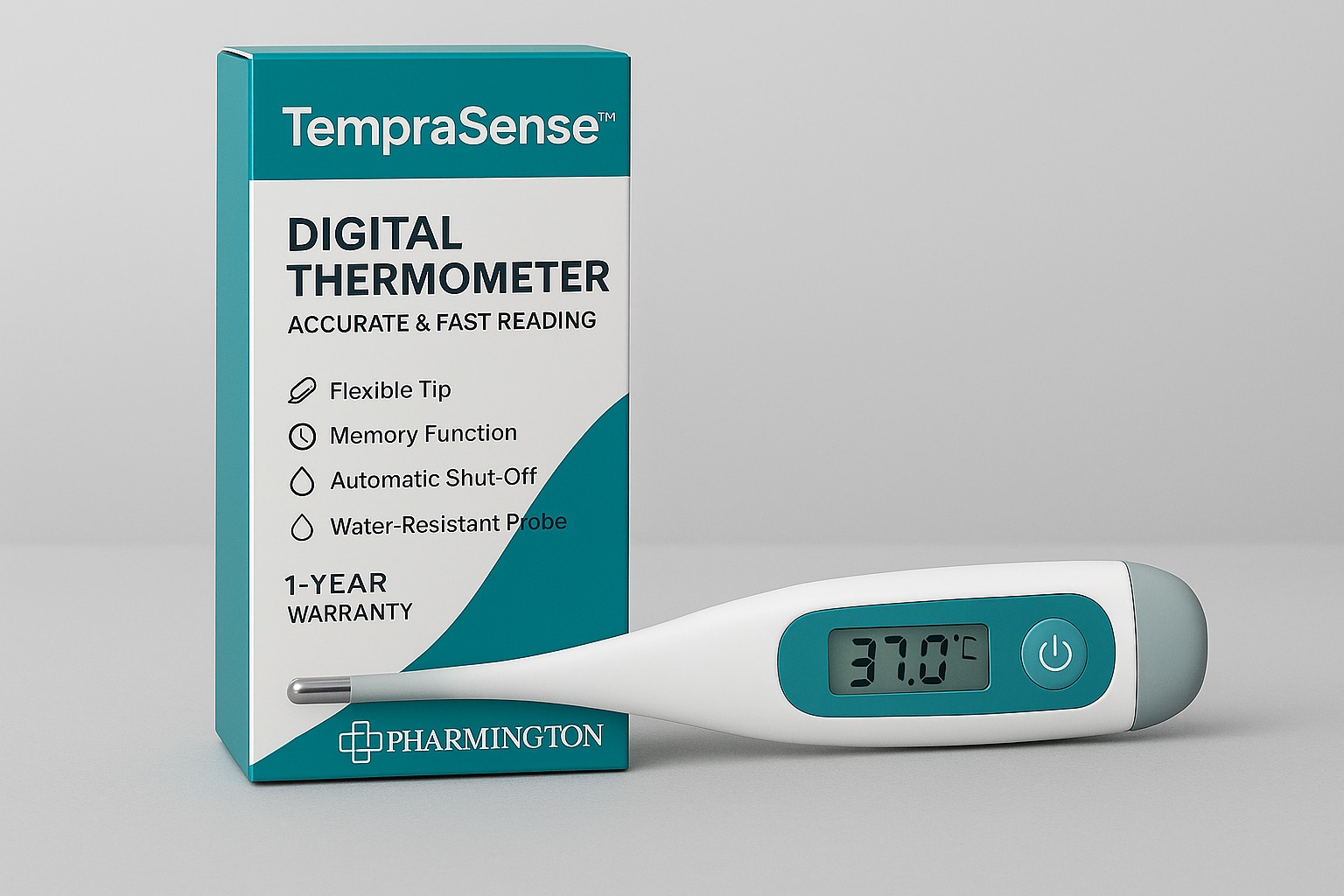
TempraSense™ is an advanced medical-grade fever thermometer designed for fast, accurate, and hygienic temperature measurement. Its ergonomic design, backlit digital display, and smart memory function make it ideal for both home use and clinical settings.
With cutting-edge sensor calibration and anti-microbial coating, TempraSense™ ensures reliable results in seconds — offering peace of mind for families, parents, and professionals.
Key Features:
Fast, accurate reading in 10 seconds
Dual-mode: oral & underarm measurement
Memory recall of last 10 readings
Fever alarm with color-coded display
Auto shut-off for battery efficiency
BPA-free, waterproof tip
Technical Specs:
Accuracy: ±0.1°C
Range: 32.0–42.9°C
Power: 1× CR2032 lithium battery (included)
Certification: CE / ISO 13485 Medical Device
£22.00
Body temperature measurement remains one of the most fundamental and clinically relevant vital signs in both acute and chronic care settings. Fever is a common physiological response to infection and inflammation, and its accurate detection plays a crucial role in clinical decision‑making, patient monitoring, and self‑care at home. The reliability, speed, and hygiene of thermometry devices significantly influence the quality of temperature assessment. (1)
TempraSense™ Smart Digital Thermometer is a medical‑grade device designed to provide rapid, accurate, and hygienic temperature measurements for both domestic and clinical use. By integrating calibrated digital sensors, ergonomic design, and user‑friendly feedback mechanisms, TempraSense™ addresses common limitations associated with traditional mercury and early‑generation digital thermometers. (2)
Normal human core body temperature is tightly regulated by the hypothalamic thermoregulatory center, typically ranging between 36.5°C and 37.5°C in healthy adults. Fever represents a controlled elevation of body temperature resulting from pyrogen‑mediated changes in thermoregulatory set points, usually in response to infection or inflammation. (3)
Accurate detection of temperature deviations is essential for identifying febrile responses, monitoring disease progression, and evaluating response to supportive or pharmacological interventions. Even small measurement errors can lead to inappropriate reassurance or unnecessary medical escalation, particularly in vulnerable populations such as children and the elderly. (4)
Modern digital thermometers rely on thermistor‑based sensors that convert temperature changes into electrical signals, which are then processed and displayed digitally. Compared with mercury thermometers, digital systems offer faster response times, improved safety, and higher measurement consistency when properly calibrated. (5)
The stated accuracy of ±0.1°C for TempraSense™ aligns with internationally accepted performance criteria for medical thermometers used in clinical screening and home monitoring. This level of precision supports meaningful trend analysis when measurements are taken consistently under similar conditions. (6)
Oral temperature measurement is widely accepted as a practical proxy for core temperature in cooperative adult patients, providing reliable readings when environmental and behavioral factors are controlled. Axillary (underarm) measurement, while generally yielding slightly lower values, is frequently used in pediatric and infection‑control contexts due to its non‑invasive nature. (7)
TempraSense™ offers dual‑mode compatibility for both oral and underarm measurements, allowing flexibility across age groups and care environments. Consistency in measurement site remains essential for accurate longitudinal monitoring. (8)
Digital memory functions can play an important role in home monitoring by enabling users and caregivers to track temperature trends over time. TempraSense™ stores the last ten readings, supporting informed discussions with healthcare professionals and reducing reliance on subjective recall. (9)
The integrated fever alarm and color‑coded display provide immediate visual feedback, enhancing usability for non‑professional users. Such features may improve early recognition of febrile episodes, particularly in caregiving scenarios involving children or dependent adults. (10)
Hygienic design is a critical consideration for reusable medical devices. The antimicrobial coating and waterproof tip of TempraSense™ support routine cleaning and reduce the risk of cross‑contamination when appropriate disinfection practices are followed. (11)
The absence of mercury and the use of BPA‑free materials contribute to device safety and environmental responsibility. Auto shut‑off functionality also enhances battery efficiency, encouraging reliable performance over extended periods of use. (12)
In clinical environments, rapid temperature measurement supports efficient patient triage and routine vital sign assessment. In home settings, reliable thermometry empowers individuals and families to monitor febrile illness and decide when medical advice may be warranted. (13)
TempraSense™ is intended for temperature monitoring only and does not diagnose disease or guide specific treatment decisions. Interpretation of temperature data should always consider clinical context and professional guidance. (14)
TempraSense™ is certified under CE marking requirements and ISO 13485, indicating compliance with European medical device regulations and quality management standards. These certifications reflect adherence to manufacturing, safety, and performance requirements applicable to non‑invasive medical thermometers. (15)
Such regulatory alignment supports its suitability for use in both professional healthcare settings and consumer health applications within the UK and EU. (16)
TempraSense™ Smart Digital Thermometer represents a precision‑focused approach to fever monitoring, combining accurate sensor technology, user‑centered design, and hygienic materials. Its dual‑mode measurement capability, smart memory features, and rapid response time address practical needs across home and clinical environments.
By supporting consistent and reliable temperature monitoring without making diagnostic or therapeutic claims, TempraSense™ aligns with evidence‑based practices in modern vital‑sign assessment and patient self‑care. (17)
What is TempraSense™ used for?
TempraSense™ is designed for accurate monitoring of body temperature to detect and follow fever. It does not diagnose or treat medical conditions. (18)
Is TempraSense™ suitable for children?
Axillary measurements make TempraSense™ suitable for supervised pediatric use, following standard temperature‑taking guidelines. (19)
How accurate is TempraSense™?
When used according to instructions, TempraSense™ provides accuracy within ±0.1°C, consistent with clinical digital thermometry standards. (20)
1. Mackowiak PA. Concepts of fever. Archives of Internal Medicine. 1998;158(17):1870–1881. PMID: 9759685
2. Wright J et al. Advances in digital thermometry. Journal of Medical Engineering & Technology. 2015;39(2):86–92. DOI: 10.3109/03091902.2014.989123
3. Dinarello CA. Pathophysiology of fever. Infectious Disease Clinics. 1996;10(2):433–449. PMID: 8798186
4. Sund-Levander M et al. Assessment of body temperature. Scandinavian Journal of Caring Sciences. 2004;18(2):122–128. DOI: 10.1111/j.1471-6712.2004.00268.x
5. Fulbrook P. Core temperature measurement. Journal of Advanced Nursing. 1997;25(2):336–346. PMID: 9035135
6. ASTM E1112. Standard specification for digital fever thermometers. ASTM International.
7. Geneva II et al. Accuracy of oral and axillary temperature. Paediatrics. 2010;126(6):e1529–e1537. DOI: 10.1542/peds.2010-1310
8. NICE. Fever in under 5s: assessment and management. UK. 2019
9. Chiappini E et al. Fever management. Journal of Paediatrics. 2012;161(4):689–693. DOI: 10.1016/j.jpeds.2012.01.054
10. Allegaert K et al. Clinical interpretation of fever alarms. Clinical Nursing Studies. 2014;2(1):1–7
11. Rutala WA et al. Disinfection of non‑critical medical devices. Infection Control & Hospital Epidemiology. 2008;29(10):1–23
12. FDA. Mercury‑free medical devices guidance. 2018
13. El‑Radhi AS. Fever and self‑monitoring. Clinical Pediatrics. 2012;51(9):818–824. DOI: 10.1177/0009922812440846
14. NHS. Using a thermometer to take your temperature. UK
15. ISO 13485:2016. Medical devices—Quality management systems
16. MHRA. Medical device regulation guidance. UK
17. Ring E et al. Temperature measurement in clinical practice. BMJ. 2007;334:561–563. DOI: 10.1136/bmj.39148.491826.BE
18. WHO. Integrated management of childhood illness. Fever section.
19. NICE. Measuring temperature correctly. UK
20. ASTM E1965. Continuous and digital clinical thermometers.
© 2025 Pharmington. All rights reserved.